Basilica Cistern, Istanbul: A Visitor’s Guide
Summary
Recently, I undertook an InterRail trip from London to Istanbul.
While in Istanbul, I visited the Basilica Cistern – A vast underground water tank created some 1500 years ago at the height of the Byzantine Empire’s rule in the then-named city of Constantinople. In my view, the visit was a very worthwhile experience.
This post provides a summary of my visit, explaining:
If you would like to find out more about my InterRail journey between London and Istanbul, details can be found in the following post.
Also, at the end of this post, details can be found of many other long distance travel adventures I have undertaken, both in Europe and in Asia.
Introduction
If you are planning to visit Istanbul in the near future, the Basilica Cistern should be near the top of your target list of attractions.
It is located very close to Istanbul’s other top landmarks, namely
- the Hagia Sophia;
- the Blue Mosque; and
- Topkapı Palace
and provides a completely different experience.
It allows you to escape the heat of the city, experience a stunning example of ancient engineering and Byzantine history and immerse yourself in an otherworldly atmosphere of sound and light.
Here is what you should know before you go.
Where is the Basilica Cistern?
The Basilica Cistern lies beneath the busy streets of Istanbul’s historic Sultanahmet district.
Known in Turkish as Yerebatan Sarnıcı, or the “Sunken Cistern,” this vast underground reservoir sits just a few hundred metres from the Blue Mosque, but far removed from the hubbub and bustle of tram cars and other modern day traffic above.
What Is the Basilica Cistern?
The Basilica Cistern consists of a huge underground water-storage chamber. It was built during the sixth century AD during the reign of the Byzantine Emperor Justinian I. This was at a time when Constantinople was one of the most important cities in the latter period of the Roman Empire
Water was supplied to the Basilica Cistern through an extensive network of aqueducts and reservoirs that transported water into the city from the surrounding areas. Its primary purpose was as a backup system to supply water to the Great Palace and other nearby important buildings. This function came into play during periods when the city’s normal water sources were unreliable.

Why is it Called the Basilica Cistern?
The term ‘Cistern’ is an engineering term that refers to a water storage system, much like the toilet cistern in your home.
The term ‘Basilica’ refers to the earlier Stoa Basilica, a public area that once occupied the site above the cistern.
What are the Numbers for the Basilica Cistern?
The Basilica Cistern structure is supported by a forest of 336 columns, arranged in 12 rows of 28 columns. Most of the columns are around nine metres high.
The cavernous chamber has a floor area of some 9,800 square metres and is capable of holding an enormous capacity of water of around 80,000 cubic metres.

What Else Can You Tell Me?
It is believed that when it was built, many of its columns were repurposed from older Roman structures that had fallen into disuse. Apparently, this practice of incorporating architectural elements from earlier buildings into new structures was common in the ancient world. Perhaps demonstrating that our present day obsession with recycling is nothing new.
This ‘recycling’ technique also means that the Basilica Cistern now contains a fascinating mixture of column styles and decorative details. These reflect many styles from earlier periods in Constantinople’s history.
Although originally built simply as a piece of buried infrastructure, rather than as a tourist attraction, the Cistern’s architecture is surprisingly beautiful.
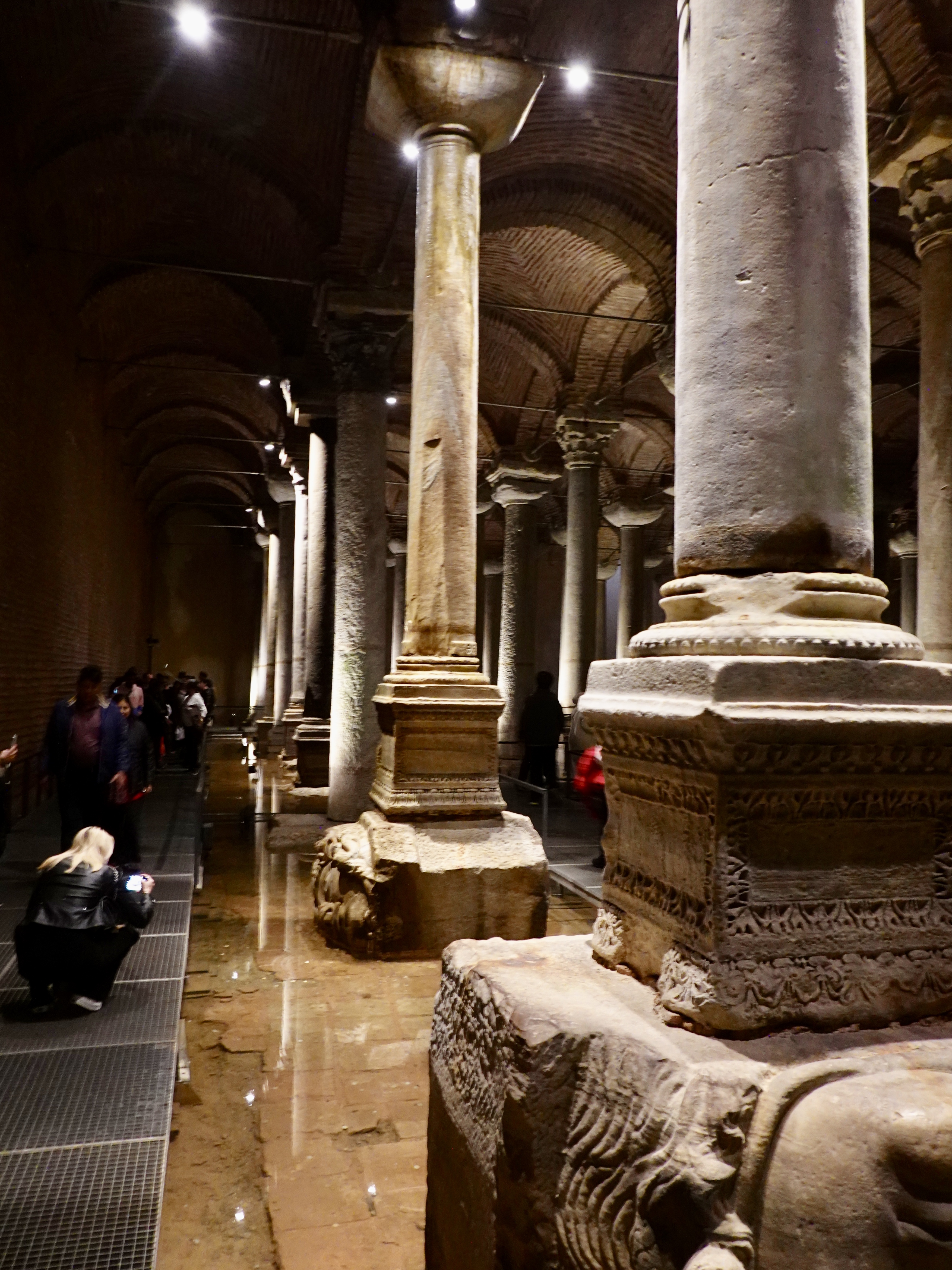
The repeating pattern of columns, both longitudinally and laterally, creates a series of long vistas, all set out beneath the vaulted brick ceiling. This, combined with the captured water at the base, produces a series of reflections, making the chamber seem even larger.
Are there any ‘Stand Out’ Architectural Features?
The Medusa Heads
Yes, the Basilica Cistern’s most ‘stand-out’ architectural features are two mysterious Medusa heads that are found situated beneath two different columns toward the back of the chamber.
These large carved supporting blocks both have depictions of the Medusa (a mythical figure from Greek mythology whose gaze was said to turn people to stone) carved into one of their faces.
One block depicts a Medusa head that is positioned sideways, while the other has an image that has been placed upside down. It is believed that both blocks were repurposed from earlier Roman buildings, rather than specifically carved as part of the Cistern’s construction. It is unknown what the original provenance of these Medusa heads might have been.

There is a popular ‘folklore’ story that, during the building of the Cistern, the Medusa heads were deliberately placed as they are so as to neutralise Medusa’s dangerous gaze.
Whatever the truth, the Medusa carvings are among the most memorable things to see inside the Cistern.
The Weeping Column
In addition to the Medusa heads, another feature worth looking for is the so-called Weeping Column or Column of Tears. Its surface is covered with unusual patterns that give it the appearance of being perpetually damp, thus giving it its nickname.
Again, as with the Medusa’s heads, there are folklore tales that say that the tears on the column are for the workers who died during the construction of the Cistern. Again, whether true or not, one can imagine that, for a feat of this type to be undertaken in the 6th century AD, many workers probably did, indeed, die before its completion.

What Is It Like to Visit the Cistern?
On first entry, visitors immediately descend below street level into a vast, cool, underground space that is supported by hundreds of ancient columns.
You’ll quickly notice that the temperature is quite a bit cooler than outside, meaning the Cistern is a particularly pleasant place to visit during Istanbul’s hot summer months.
You will also notice that the combined impact of the sights within the cavern:
- the Cistern’s water;
- the brick vaults;
- the subdued lighting; and
- the resulting reflections
make the experience unlike almost any other attraction in Istanbul.
As you proceed through the cavern, a raised walkway takes visitors through the reservoir area, allowing you to look closely at the columns and the shallow water below.

Careful use of lighting within the chamber highlights the key architectural features of the Cistern, creating constantly changing reflections across the water.
Take your time as you pass along the walkway, take as many photographs as you like, and don’t be put off by those behind you who just want to rush through.
The experience should not just be about ticking off your pictures of the Medusa’s heads and the Weeping Column.
Instead, it should be more about appreciating the overall atmosphere and marvelling at how, some 1,500 years ago, the engineers of the Byzantine Empire were able to conceive of and execute the construction of such a project. Not just the Cistern itself, but also the miles of aqueducts that were necessary to transport the water into the cistern.
In today’s terms, such a project would have been equivalent to constructing a new metro line or inter-city motorway, all without the aid of any modern-day machinery.
Also, while walking through, take your time to:
- look up at the brick vaults;
- take notice of the detailed carvings on the reused columns; and
- note the symmetrical layout of the columns and their reflections in the water
All of the above are enhanced by the dramatic lighting, and all of these images provide excellent opportunities to try out your skills in capturing truly amazing architectural photographs.

What are the Opening Hours of the Basilica Cistern
The official website (www.yerebatan.com) lists the opening hours as being from 09:00 to 22:00 every day.
How much are the Ticket Prices
The official website also lists different admission prices for daytime and evening visits. Published prices are currently:
- 1,950 Turkish lira for entry between 09:00–18:30; and
- 3,000 Turkish lira for entry between 19:30–22:00.
It is understood that ticket payments can be made by either credit / debit card or İstanbulkart. Visitors are also advised to purchase tickets through the official website rather than unauthorised sellers.
It is also advised that during busy times, Istanbul’s attractions can become very busy. It is therefore advised to check the latest ticketing information prior to arriving at the venue.
My Experience of Ticketing Issues
To be honest, having looked at the official website, buying tickets through it as a foreigner seems very difficult.
In reality, I think you have three options for buying an entry ticket
- Queue up on the day and pay 1950 Turkish lira at the box office
- Try to figure out how to book through the official website, again paying 1950 Turkish lira and avoiding waiting in the ticket queue
- Give up and buy a Skip the Line ticket through Get Your Guide for around 57 Euros ( 3,150 Turkish lira). This approach, although extremely expensive, does get you a ‘free’ audio guide to download to your phone.
Whichever approach you decide to adopt, you still need to queue up for a ‘security check’ to get into the museum.
Not very satisfactory, I know!!
I visited in November and just paid at the box office. From what I remember, it only took me around 10 minutes to get in at that time of year.
Despite all this hassle, however, it’s still worth visiting.
By the way, in case you’re wondering, 1950 Turkish lira equates to around 35 Euros. – Expensive enough anyway, but maybe it’s good that the museum is extracting money from foreign tourists – Domestic tickets are much cheaper.

When Is the Best Time to Visit?
As with most tourist attractions in Istanbul, demand to visit the Basilica Cistern can be very high at times. If you want to enjoy a quieter experience, consider arriving close to opening time or visiting later in the day.
The evening opening period can also provide a particularly atmospheric experience, but it currently has a higher admission price.
You should allow yourself at least one hour for your visit and perhaps longer if you are deeply interested in Byzantine history and / or the detailed engineering / architectural features of the Basilica Cistern museum.
Also remember, as the Cistern is underground, it is an excellent attraction to visit on a rainy day. It is also cool, so its enclosed environment could provide welcome relief from extreme summer temperatures.
Remember, though, other visitors may have the same idea, making it busier.
How Do You Get to the Basilica Cistern?
The Cistern is located in Sultanahmet, Istanbul’s historic peninsula.
Its address is Yerebatan Caddesi, Alemdar Mahallesi, Fatih.
Its central location, in this historic hub of the city, makes it particularly easy to combine a visit to the Cistern with visits to other major attractions.
- Hagia Sophia is only a short walk away, while
- the Blue Mosque and Topkapı Palace are also within the historic centre.
All three, though, are very popular attractions, so prebooking each is highly recommended.
Other nearby attractions in the area include:
- The Grand Bazaar
- The departure point for boat cruises on the Bosporus
The former is free to visit, and the latter is a surprisingly cheap excursion, particularly if booked at the departure point.

Tips for Your Visit
When visiting the Basilica Cistern and other nearby attractions, you are advised to:
- Wear comfortable footwear, – while the visitor route is relatively straightforward, you will be walking and standing for much of your visit.
- Bring a camera – remember, though, that the interior of the Cistern is deliberately dimly lit. Choosing a smartphone or a camera that is capable of performing well in low light conditions will produce better results.
- Allow yourself enough time while visiting the Basilica Cistern to find the Medusa heads and the Weeping Column.
- Also, look beyond the most obvious views. Some of the most interesting details are found in the less immediately spectacular columns and architectural fragments.
- Finally, check the official website before setting out. Opening hours, ticket prices and visitor policies can change.
Is the Basilica Cistern Worth Visiting?
Yes, based on my own experiences, and also on comments made by many others that I have spoken to, I would rank a visit to the Basilica Cistern among the top three ‘must do’ attractions to visit, particularly if you have a passing interest in history, engineering or architecture.
It offers something very different from the city’s mosques, palaces and museums. Its combination of Byzantine engineering, reused Roman architecture, mythology and atmospheric lighting makes it one of Istanbul’s most distinctive experiences.
Whether you are interested in history, architecture, photography or simply unusual places, the Basilica Cistern deserves a place on your Istanbul itinerary.
Other Top Attractions in Istanbul
While you are in Istanbul, other attractions that are worth visiting include:
Hagia Sophia – This is Istanbul’s most iconic landmark, renowned for its enormous dome, Byzantine mosaics and extraordinary history. Built in 537, it has, over time, served as a cathedral, a mosque, a museum and a mosque again. It beautifully reflects the meeting of Byzantine Christianity and Ottoman Islamic traditions. (Entry ticket and downloadable audio guide)

Blue Mosque (Sultan Ahmed Mosque) – Facing Hagia Sophia, the magnificent Blue Mosque is one of Istanbul’s finest examples of classical Ottoman architecture. Built in the early seventeenth century, it has six minarets, elegant domes and thousands of İznik tiles. (Entry to the Mosque is free of charge)
Topkapı Palace – This was the principal residence of Ottoman sultans for almost four centuries and provides a fascinating glimpse into imperial life. Its courtyards, gardens, treasury, kitchens and Harem contain remarkable collections of jewellery, manuscripts and religious artefacts. From its location, beside the Bosphorus, the palace offers superb views across Istanbul. (Entry ticket and downloadable audio guide)
Grand Bazaar – This is one of the world’s oldest and largest covered markets, with thousands of shops spread through a maze of colourful passages. Visitors can browse carpets, jewellery, ceramics, leather goods, textiles, lamps and souvenirs. Even if you don’t buy anything, just wandering its bustling streets provides an unforgettable taste of traditional Istanbul. (Free)

Bosphorus Cruise – Taking a short cruise along the Bosphorus to the 2nd Crossing bridge is one of the best ways to appreciate Istanbul’s unique geography, with Europe on one side and Asia on the other. As you pass along the strait, you’ll pass Ottoman palaces, historic mansions, mosques, fortresses and modern waterfront neighbourhoods. (Tickets for 90 minute cruise)


Sights Seen from a Bosphorus Cruise, Istanbul, Turkey
Galata Tower – This is a historic stone landmark rising above the Galata district. Originally constructed in medieval times and subsequently rebuilt, the tower provides spectacular views across the Golden Horn, the Bosphorus and the Old City area. The surrounding neighbourhood is equally appealing, with cafés, restaurants, boutiques and atmospheric streets to explore. (Entry ticket and downloadable audio guide)

Dolmabahçe Palace – Built in the 19th Century and set beside the Bosphorus on the European side, this Palace represents the Ottoman Empire’s fascination with European-style architecture and decoration. Its lavish interiors feature crystal chandeliers, ornate furnishings, grand ceremonial rooms and extensive gardens. (Entry ticket and downloadable audio guide)
Süleymaniye Mosque – This Mosque is one of Istanbul’s great Ottoman masterpieces. It was designed by the celebrated architect, Mimar Sinan, for Sultan Süleyman the Magnificent. Its enormous dome, elegant proportions and peaceful courtyard are impressive, and its elevated position provides wonderful views over the Golden Horn and historic city. (Entry to the Mosque is free of charge)
Spice Bazaar (Egyptian Bazaar) – This vibrant market, near the Golden Horn, is filled with colourful displays of spices, Turkish delight, dried fruit, nuts, teas and traditional sweets. Its fragrant atmosphere makes it particularly enjoyable to explore. Although smaller than the Grand Bazaar, it offers an excellent introduction to Istanbul’s trading heritage and culinary culture. (Free)

Rumeli Fortress – Built by Sultan Mehmed II in 1452, shortly before the Ottoman conquest of Constantinople, this fortress occupies a strategic position overlooking the Bosphorus. Its massive walls, towers, and elevated location demonstrate its military importance. Visitors can explore the fortress grounds and enjoy impressive views towards the Asian side of the Strait. (Entry ticket and downloadable audio guide)

Where to Stay in Istanbul
An Overview
The following provides a list of well reviewed and highly recommended hostels, budget hotels and mid-range hotels in the central areas of Istanbul (on the western side of the Bosphorus Strait). The list has been compiled from an examination of reviews provided on both Booking.com and Hostelworld.com.
General Rules on Choosing Accommodation
As always, when deciding which accommodation to book, you should do your own research. The Golden Rules when reading reviews are that you should:
- Only select accommodation that is well reviewed (i.e. those that have over, say, 500 reviews)
- Be wary of reviews that predominantly praise the friendliness of the staff and say little else
- Only select those hostels / hotels that have a high reader rating.
Lastly, but most importantly, you should read all of the reviews and the property’s own detailed information and ensure that the accommodation meets your needs (i.e.):
- Is it in the right location (near the station, beach, etc.)
- Does it have a lift
- Does the room come with its own ensuite bathroom
- Does the room provide a double or single bed
- Is there a desk in the room
- Does it offer luggage storage,
- Does it provide breakfast,
- Is there a communal area, etc.
Also remember, if you just want cheap, you’ll probably get cheap.
Possible Hostel Type Accommodation
Cheers Hostel, Sultanahmet – Cheers Hostel is situated right in the centre of Sultanahmet, making Hagia Sophia, the Blue Mosque and Topkapı Palace exceptionally convenient to reach. Guests consistently praise the friendly staff, social atmosphere, breakfast and rooftop bar with views across the historic city. For a solo traveller wanting a lively hostel with an outstanding review record, this would be a top pick.
Cheers Vintage Hostel, Sultanahmet – Cheers Vintage Hostel offers another highly rated option in the heart of Sultanahmet, just a few minutes from the Blue Mosque and Hagia Sophia. Again, its rooftop terrace, breakfast and organised social activities are repeatedly highlighted as being good, making it particularly suitable for solo visitors.
Bahaus Guesthouse Hostel, Sultanahmet – Bahaus Guesthouse Hostel is extensively reviewed as offering value for money. It occupies a very central position close to Hagia Sophia, the Blue Mosque and Topkapı Palace. Guests particularly praise its friendly staff, social atmosphere, rooftop terrace and its location. There has been some concern, though, in respect of the overall cleanliness of the hostel.
Big Apple Hostel, Sultanahmet – The Big Apple is a long-established hostel in Sultanahmet, with an excellent location close to the Blue Mosque and Hagia Sophia. Guests frequently praise the hostel’s helpful staff, its rooftop terrace, its social atmosphere and its good value.
Le Banc, Beyoğlu/Galata – Le Banc is ranked as the best choice hostel if you would rather stay in the Galata and Beyoğlu area of the city, rather than Sultanahmet. It is close to the Galata Tower and offers a social atmosphere, terrace, shared kitchen and modern accommodation, with guests praising its staff and location.
Possible Budget Hotel Type Accommodation
Boss Hotel, Sultanahmet – The Boss Hotel is a popular budget-friendly choice located in the historic Sultanahmet area, within easy walking distance of Istanbul’s principal attractions. It provides a practical base for a first visit to Istanbul, being situated in an area that has plenty of restaurants, cafés and public transport connections.
Asur Hotel, Sultanahmet – The Asur Hotel is located in the old city area and provides convenient access to Hagia Sophia, Topkapı Palace, the Grand Bazaar and the waterfront. It is rated as providing good value for those travellers who want to stay in the historic centre at a budget price.
Marmara Deluxe Hotel, Sultanahmet – The Marmara is a compact property located in the old city. It provides an excellent base for exploring Istanbul’s historic peninsula. The hotel is surrounded by restaurants and cafés and is close to tram and rail connections, making sightseeing within the wider area straightforward. It is best suited to independent travellers looking for a centrally situated hotel at a relatively modest price.
Best Western Empire Palace, Sultanahmet – This Best Western is a traditional-style hotel located in the old city, close to the major sights of the Old City. The hotel combines a historic Istanbul atmosphere with the predictable facilities associated with the brand. Its location makes it particularly convenient for travellers planning to walk to the Hagia Sophia, Topkapı Palace and Grand Bazaar.
Possible Midrange Hotel Type Accommodation
Hotel Erboy, Sirkeci – The Hotel Erboy is very conveniently located in the Sirkeci area. It provides modern rooms and is within easy walking distance of many of Istanbul’s most important historic attractions. It is also conveniently located for access to public transport. This is an excellent choice for those travellers who are willing to spend a little bit more for comfort.
Mercure İstanbul Sirkeci Hotel, Serkeci – This modern Mercure property offers contemporary accommodation in one of the most convenient parts of the historic centre. It is particularly well located for visitors who want easy access to Sirkeci station, the tram and the principal Old City sights. The hotel is a good choice for travellers who prefer modern international-style accommodation.
DoubleTree by Hilton Istanbul, Sirkeci – This DoubleTree offering is a more upmarket choice, providing the familiar facilities and service standards associated with the DoubleTree brand. It is located close to the Hagia Sophia, Topkapı Palace, the Spice Bazaar and the Bosphorus waterfront. It is particularly attractive if you want a comfortable, polished hotel within the historic centre.
Cronton Design Hotel, Sirkeci – This is a stylish boutique hotel located in the Sirkeci area and sensibly situated for sightseeing, dining and access to public transport. It combines contemporary design with the historic atmosphere of Istanbul’s Old City. It is particularly attractive to travellers who care about interiors and want somewhere with more personality than a conventional chain hotel.
Legacy Ottoman Hotel, Sirkeci – This hotel is housed in an imposing historic building in the heart of the Old City. It has considerably more architectural character than a typical modern property. It is near Eminönü and the Spice Bazaar and is excellent for exploring both the historic peninsula and the waterfront. It’s a good option for those who are looking for a substantial hotel in a distinctive Istanbul setting.
Some Useful Travel Related Resources
Booking Accommodation
Budget hostels, private apartments or hotel accommodation can be found using this link to Booking.com, the most trusted accommodation booking service on the internet.
Booking Luggage Storage
If you haven’t got time to stay overnight in any place, but still want somewhere to store your luggage during the day to go sightseeing, Radical Storage are brilliant.
They have a network of luggage storage facilities in most towns and cities worldwide. You can reserve a space online and pay by iPay or similar just a few minutes before you need to drop your luggage off, or book in advance.
The online website will give you a quotation, issue you with a QR code to show to the local operator and provide directions to the shop / facility (together with a grid reference).
Nothing could be simpler. They also provide luggage insurance just in case something goes wrong. Hopefully you won’t need it – in my view, it just illustrates their trust in their local partners.
Find out more about Radical Storage
Booking Train Tickets
If you plan to go travelling in Europe, InterRail passes are a great way to save money. They are available for country specific travel or for Europe-wide travel and valid for just a few days or up to three months. These passes can be obtained directly from InterRail as follows:
If you buy your InterRail pass in the November Black Friday sale or the March / April Spring sale, you can usually get a 25% discount on the price of all passes. Additionally, if you are under 28, you get an extra 25% discount anyway. Similarly, an extra 10% discount is also available for those who are 60 or over.
In my experience, buying a Europe-wide pass provides much better value than buying country specific passes. Similarly, the longer the validity period of the pass, the cheaper the passes become from a daily cost viewpoint.
If you want to book train tickets outside Europe, then the following link may be useful. It can also be used to book individual train tickets within Europe if you don’t require the flexibility of an InterRail pass.
This website provides all the details you need: train times, connections and prices, and it also allows you to book tickets there and then online. No need to navigate train operator sites, translate from a foreign language or deal with currency conversions.
Further Reading
Details of My Long Distance Overland Adventures
Further Details on my Travels from London to the Arctic Circle
Other Travel Related Blogs
Useful Country Factsheets
Who Are Your Favourite Travel Writers
Please Provide Feedback
Hi, thanks for reading this far. I would really appreciate it if you could please provide some feedback on your reading experience. It will allow me to further improve my offering.


Tags:
#BasilicaCisternIstanbul #BasilicaCisterntickets #BasilicaCisternopeninghours #YerebatanSarnıcı #BasilicaCisternhistory #MedusaheadsIstanbul #thingstodoinIstanbul #Istanbulattractions #Sultanahmetattractions #Istanbultravelguide