Disclaimer: Some of the links within this post are affiliate links. This means if you click them and make a purchase I might earn a small commission at no additional cost to you. These commissions, although small, help towards paying the costs of running this website. For further information please see our privacy policy and cookie policy. In addition if you wish to ensure that your personal information is not passed on to third party advertisers you can request that via our Do Not Sell or Share My Personal Information page.
Top Attractions – Copenhagen on Foot
Summary
This post details my stay in Copenhagen.
Overall, I was in the city for less than 36 hours as part of my three week budget solo train journey to the Arctic Circle and back.
If you want to undertake a similar long distance adventure you can book train tickets and budget accommodation using the links below:
In this post I concentrate on my visit to Copenhagen, detailing my arrival, my sightseeing activities and my thoughts.
For easy reading the post is divided into a number of sections and sub-sections, as set out in the ‘Page Contents’ tab.
The majority of the post revolves around my activities and thoughts while walking in Copenhagen. A free Copenhagen walking tour map is provided showing the route I took through the city centre and the key landmarks I visited.
Although Copenhagen is expensive compared to many other European cities it is still possible to visit on a budget providing you use hostel type accommodation, don’t eat out in restaurants and limit your alcohol intake. (Discussion is provided on all these issues – See Copenhagen’s high cost of living, budget accommodation and local foods).
In addition the post also identifies many more top attractions to visit in and around Copenhagen;


As a heads up, if you are going to visit Copenhagen soon it might be worth purchasing a ‘Copenhagen City Card’. It provides free access to over 80 attractions and also allows free use of public transport. You can find out more information below:
Alternatively, if you’re limited for time, you could consider the city’s ‘hop-on / hop off’ bus service. This will allow you to get around more quickly but is of course a more expensive option.
My Walking Route Through Central Copenhagen
Is Copenhagen Walkable?
Just in case you are wondering, Copenhagen is a very walkable city. – It’s flat, it has extensive car free areas, it’s full of interesting places to visit and it has a good coffee culture. As a result it is regularly ranked as one of Europe’s most walkable cities
Copenhagen Walking Tour
To prove it, the free self guided Copenhagen walking tour set out below follows my walking route through the city.
It starts from Copenhagen Central Station and visits:
- Tivoli Gardens – A city centre Amusement Park;
- City Hall – An example of National Romantic architecture
- Strøget and Amagertorv – Copenhagen’s prime shopping street;
- Nyhavn – Copenhagen’s modern day No. 1 tourist attraction;
- Copenhagen Waterfront – providing splendid views across Copenhagen Harbour;
- the Amalienborg Palace – home of Denmark’s royal family;
- Frederik’s Church – a magnificent domed marble church;
- the Little Mermaid – arguably still Copenhagen’s real No. 1 tourist attraction; and
- the Kastellet – one of the best preserved star fortresses in Northern Europe;
before returning to Central Station by train via Østerport Station
Copenhagen Walking Tour Map

My Arrival
The Annex Copenhagen Hostel
On arriving at Copenhagen Central Station, at 5pm, it is a short walk to my lodgings at Annex Copenhagen, a reasonably upmarket hostel providing a private room with shared bathroom.
The room is relatively small but clean and heated. The shower facilities are also clean and are located nearby.
The major upside of this hostel is that it is accessed through the adjoining Absalon Hotel so you have all the facilities of a 4 star hotel at a hostel price. These include a bar, a reception seating area and access to an automated launderette facility.
Overall, a good find all round.
You can find out more about the Annex Copenhagen below:
Talking of automated launderettes, this hostel is my first introduction to the Scandinavian revolution of ‘Self Service hotel Check – ins’. Everything, including delivery of a door card key, is achieved via a ‘self – service’ computer screen and keypad. All you need is your booking reference and passport details and you’re in. I suppose with the high cost of labour in Scandinavia it all makes sense.
Denmark’s Cashless Society
Retiring to the bar for a well earned beer I quickly understand better this cost of living issue – a 0.5 litre beer is around £8 in English money. What’s more, when I go to pay for it I discover for the first time that Denmark doesn’t partake in the Euro. Instead everything is in Krone so I have to pay by credit card – What am I now going to do with all these Euro I have in my wallet !!!!
As my journey proceeds I also start to realise how obsolete paper money has become. Nearly everywhere, throughout Scandinavia, seems to accept credit cards even for the smallest items – A trend that, likewise, now seems also to be becoming the norm in the UK. Indeed, in some locations in the UK (i.e. – within football stadiums) cash is simply not accepted. One must start to wonder whether the tourist based ‘Currency Exchange booth’ business has much of a future going forward.
Post Edit Note: Reading this again, some five years on (2025) it is amazing how quickly the world changes – I never carry any coins with me now and very rarely use cash machines
A Nighttime Stroll
After my beer I venture out into the night air to explore a little. Two things strike me during my evening stroll. The first is how cold it has suddenly become in the evening and the second is that at night Copenhagen has a slightly old fashioned sentimental feel about it.
I suppose the first should not be a surprise to me, after all, it’s getting towards the end of September and Copenhagen is roughly the same latitude as Edinburgh – What I do need to do though is to start wearing a sweater at night. I’m now glad that I packed for all eventualities.
Tivoli Gardens
The second is drummed home by the sight of Tivoli Gardens – an amusement Park situated right in the middle of the city. This brings back childhood memories of when London had its own permanent Battersea Park Funfair all those years ago. I note that this Copenhagen version still seems to be popular with the locals, judging by the queue at the ticket office.
If you want to visit Tivoli Gardens you can find out more information and purchase advance tickets by using the link below:

A Coffee in the Cold Night Air
Resisting the temptation to sample the rides within Tivoli Gardens I instead find a coffee house and settle down for a latte and cheesecake.
While sitting outside Cafe Vivaldi, wrapped up in a cafe owned blanket and watching the world pass by I wonder, between shivering fits, just how I am going to survive when I eventually reach the Arctic Circle.
My Day of Exploration
Retracing Last Night’s Footsteps
Retracing last night’s footsteps I set out for a day’s walking in Copenhagen.
Starting out from the hostel I remember that I have no local currency so it’s off to the station’s bureau de change for money – 30 Euros buys 210 Krone, whatever they are. The exchange rate at the station is not that good but it’s convenient. Hopefully, I can use a credit card for most purchases anyway.
Seeing the entrance to Tivoli Gardens in the daylight is much less magical than its image at night. Less people around also, but at least it’s not as cold as last night.

City Hall
My first stop while walking in Copenhagen is the City Hall. Built between 1892 and 1905, Copenhagen City Hall is styled on earlier town halls built in Italy and is today considered to be classic example of the National Romantic style of architecture. This is reflected in its richly decorated exterior and detailed interior. The building is free to visit and free guided tours are available.
After taking a photograph or two of the building and of City Hall Square I take a quick look at Google Maps to see where I want to go.
Strøget
Strøget seems a good place to start and it’s generally going in the right direction. Entering the pedestrianised street from City Hall Square my first impressions are that it’s a bit run down, considering it’s supposed to be the main shopping street of the city. Lots of souvenir and clothes shops, with pavement displays outside.

Amagertorv and its High Class Shops
As you progress along the street however, (after it changes its name), the quality of the shops gradually improves and by the time you reach Amagertorv you are in the world of Prada, Gucci, Burberry and Cartier.
Copenhagen’s High Cost of Living
I suppose in a capital city like Copenhagen, where average salaries are around £5,000 per month it’s not surprising to find such shops. However, it always amazes me that exactly the same type of shops exist in the central areas of many Asian cities such as Jakarta and Manila.
In such places the majority of the working population earn much, much less, with average monthly salaries being less than £1,000 per month.
One has to wonder if these upmarket shops ever make a profit in such places.
Perhaps, to emphasise the costs of living in Copenhagen this bill board, seen just after turning out of Strøget, demonstrates that Netto, at least, realises that not everyone is lucky enough to earn a Copenhagen resident’s £5,000 per month.

An Alternative to Strøget
By the way, as an alternative to walking along Strøget with its named retail offerings, the narrow streets to the southeast, between Strøget and Gammel Strand, are much more interesting. These streets are packed full of local shops and a wide variety of restaurants and bars.

Kongens Nytorv
Leaving Stroget I walk adjacent to Kongens Nytorv on my way to Nyhavn. As a brilliant example of self promotion this poster is seen covering much of the south western face of the French Embassy at the corner of Kongens Nytorv and Bredgade. A good example of exploiting free advertising opportunities to promote the culture of your country. I wonder if they needed a planning permit to put that there.

Nyhavn
Talking of self promotion, Nyhavn is the picture postcard symbol of Copenhagen. As is to be expected, it is teaming with tourists and the setting of the 17th Century buildings along its north side are somewhat compromised by the tat at ground level.
Nonetheless, like the Albert Dock in Liverpool, it is a very good example of the urban regeneration of a decaying former dockside area.
Nearly every building, in addition to their obligatory umbrelled sun terraces outside, now contains a bar or restaurant. Here you can presumably while away the day and say ‘I was here’ and take the photograph to prove it.
What I had not appreciated from the ‘postcard’ images of Nyhavn is that it is actually just a narrow canal dock and not a fully fledged waterfront.
Interesting facts that you may or may not know are that Hans Christen Andersen lived, at different times, in three of the houses fronting onto Nyhavn and No 17 Nyhavn apparently houses the world’s oldest functioning tattoo parlour – I’m pretty sure though, someone will come back and challenge this latter fact.

Amalienborg Palace
Moving on, while walking in Copenhagen, I move from the massed regiments of tourists in Nyhavn to the point where it meets the waterfront of Copenhagen Harbour and then proceed along the waterfront to the entrance into Amalienborg – the palace home of the Danish royal family.
For all the talk about the Danish royal family living a much more modest life style than our British monarchs, the Amalienborg still looks to me to be a cut above your typical family residence. Nonetheless, like our own royal family, they seem to be doing a pretty good job in attracting tourists to their home, albeit not perhaps as popular as the bars in Nyhavn.

The Danish royal family also have their very own Royal Guards to look after them, complete with furry hats, rifles and bayonets – God, standing on point duty outside the palace for hour after hour must be one of the most boring jobs out there. It hardly fits the hype around joining the armed forces and seeing the world. It’s more like, join the armed forces and let the world come and look at you.
If you want to visit the Amalienborg Palace Museum you can purchase tickets using the link below. As of January 2026 they can be obtained for £15.00 per person.

Frederik’s Church
Not to be outdone, the Evangelical Lutheran movement (the Danish State Church) has its own building just to the north of the Royal Palace. This building, the Frederik’s Church, is known locally as the ‘marble church’ on account of much of it being built of marble.
Apparently, although its construction was first proposed in 1740, it was not completed until 1894 due to funding issues – Gaudí‘s Sagrada Família in Barcelona is not unique then in its construction time scale.

Copenhagen Harbour Waterfront
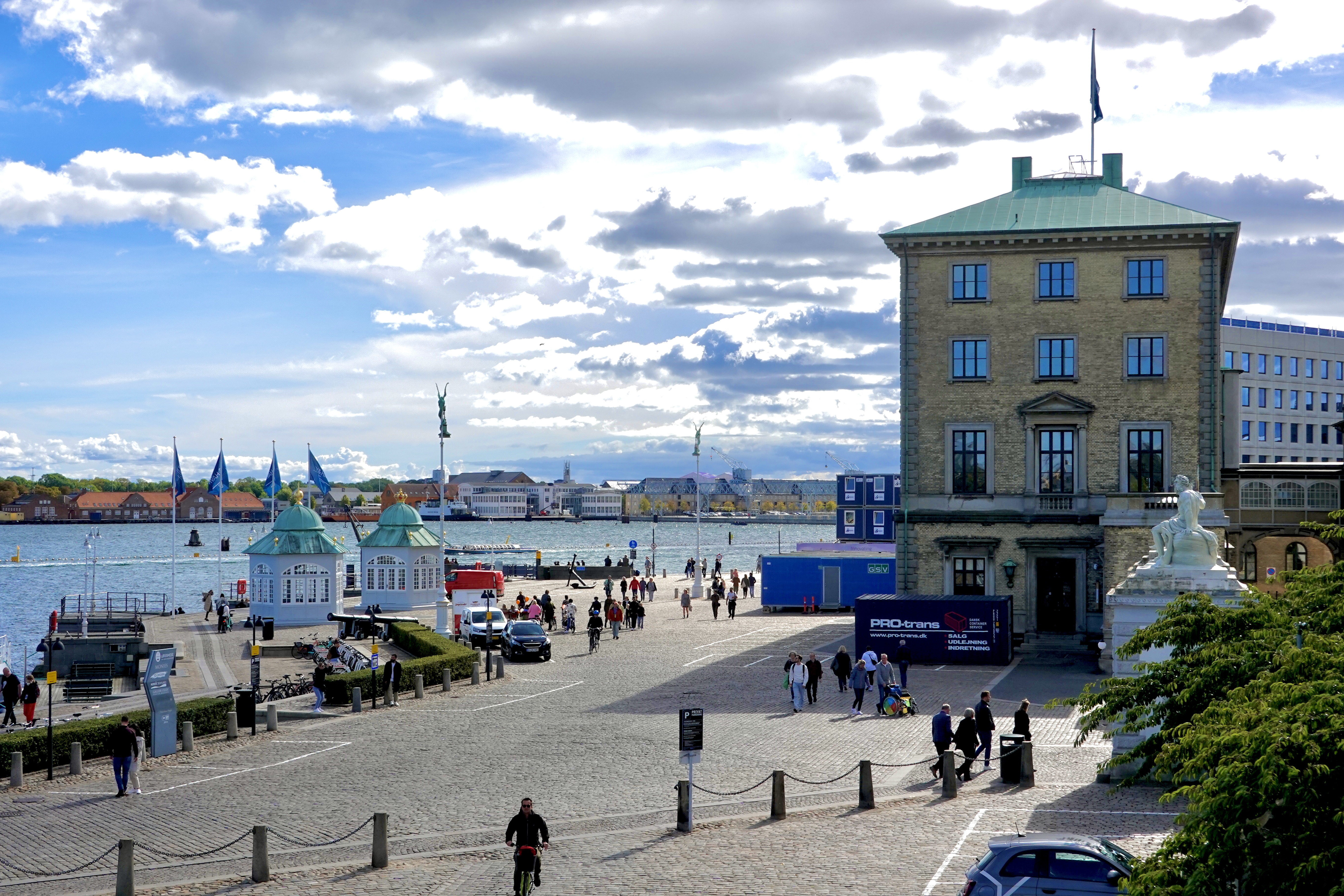
From Frederik’s Church it is a short walk back to the waterfront of Copenhagen Harbour and onward to the Little Mermaid.

Copenhill (Amager Bakke)
The walk is worthwhile if only for the views across the Harbour and also towards Copenhill (also known as Amager Bakke).
This is a heat and waste-to-power plant that doubles as an artificial ski and snowboard slope. This multi-purpose building is promoted as one of Denmark’s leading contributions towards the achievement of ‘net zero’.
I’m not sure if this claim is based on the fact that it saves the need for Dane’s to fly to the Alps for their holidays or the design of the power plant. Either way, it must be more sustainable than Dubai’s equivalent artificial ski slope.

The Little Mermaid
The Little Mermaid, although obviously a must see attraction for any visitor to Copenhagen, is actually a bit underwhelming. Surprisingly though, at the time of my visit at least, it is not as thronging with tourists as I expected.
Perhaps this reflects the long walk required to reach it or maybe the fact that there are no beer bars nearby. Nevertheless, I did notice tourist coaches parked nearby so perhaps I was just lucky.

A Farewell to Copenhagen
On my way back to my hostel, unknown to me, I walk past the Kastellet, apparently one of the best preserved star fortresses in Northern Europe – I really must make more use of Google Maps when out sightseeing.
Anyway, I make use of the nearby Østerport Station to catch a train back to Copenhagen Central Station and return to the hostel for a laundry session, followed by a couple of expensive beers before retiring to bed.
Tomorrow it’s a very early start to cross the Øresund Bridge to Sweden, before travelling onward to Malmo and Stockholm.
Further Information
What Other Attractions Are There in Copenhagen
Buildings and Gardens
- Rosenborg Castle: A renaissance castle with elegant rooms and beautiful gardens (Tickets here)
- Christiansborg Palace Once home to kings and queens, it now houses the Danish Parliament, the Supreme Court, and the Ministry of State. You can visit the state rooms and walk in the footsteps of royalty. (Tickets here)
- The Round Tower: A 17th-century observatory tower providing panoramic views of Copenhagen’s rooftops. (Tickets to be purchased on the day)
- The Botanical Gardens: A tranquil oasis of lush greenery, beautiful flowers, and exotic plants. (Tickets here)
- Frederiksborg Castle, Hillerød: A majestic example of Renaissance architecture. Built in the early 17th century by King Christian IV, it is situated on three islets in the castle lake. It houses The Museum of National History. (Tickets here)
Museums and Art Galleries
- The National Museum: Provides an insight into Danish history and culture through it’s extensive collection of artifacts (Tickets here}
- The National Gallery: Displays an extensive collection of art from the Middle Ages to the present day, including works by Danish and international artists. (Tickets here)
- Design Museum: Exhibits the best of Danish design, from furniture and fashion to graphic design and industrial products. (Tickets here)
- Thorvaldsens Museum: Contains the works by the famous Danish sculptor Bertel Thorvaldsen in a stunning neoclassical museum. (Tickets here)
- Natural History Museum: Provides insights into the natural world, both through permanent exhibits and through world leading exhibitions (Tickets here)
Other Attractions
- Copenhagen Zoo: A world of fascinating species and experiences, with more than 4,000 animals from around the world. (Tickets here)
- The Carlsberg Brewery: Learn about the brewing process while tasting some of Denmark’s finest beers. (Tickets here)
- Christiania: A unique self-proclaimed autonomous neighborhood known for its alternative lifestyle and colorful street art. (Walking tour tickets available here)
- The Meatpacking District: A neighbourhood of trendy bars, restaurants, and clubs
If you have visited any of these attractions please leave a comment on your experiences.
What Should You Eat While in Copenhagen
Bread based Delicacies
- Rugbrød: A dense rye bread with various toppings.
- Smørrebrød: An open-faced sandwich with various toppings.
- Sol over Gudhjem: A rye bread with smoked herring, egg, and radish
- Leverpostej: A liver pate spread placed on bread.
Soups
- Hønsekødssuppe: Chicken soup with vegetables and dumplings.
Meat based Dishes
- Flæskesteg: Roast pork, typically served during holidays.
- Stegt Flæsk: Crispy pork belly.
- Biksemad: Hashed meat and potatoes, often served with a fried egg.
- Frikadeller: Danish meatball.
- Rød Pølse: Red sausages often served in a hot dog bun.
Fish Dishes
- Gravad Laks: Cured salmon with mustard sauce.
- Smoked Herring: Smoked herring fish, often with onion.
Vegetable Dishes
- Kartoffelsalat: A Danish potato salad.
Desserts / Pastries
- Æbleskiver: Rounded pancake balls with powdered sugar and jam.
- Kringle: A sweet pastry, similar to a pretzel.
If you find any other local foods that are a must-try please add them to the comments on this post.
Click on the images below to buy your Pocket Guide Books to Copenhagen


Where Should You Stay in Copenhagen
Accommodation Overview
Accommodation in Copenhagen is generally expensive, even at budget level. To ensure you secure the most affordable deals it is recommended to book early.
Budget accommodation options are generally located in the Vesterbro / Central Station area while mid-range options are spread more widely across the city centre and waterfront areas.
Some possible recommendations for budget and mid-range accommodation options are set out below:
Budget Accommodation
- Annex Copenhagen – Situated close to Central Station with dormitories and private rooms. Simple but reliable accommodation. Part of Absalon Hotel, thus offering additional facilities.
- CityHub – 1.3 km from Tivoli Gardens, featuring 24 hr front desk, free wifi, air-conditioning, sauna, bar and luggage storage. Offers pod-style units best suited for solo travellers and couples.
- Generator Copenhagen – well known hostel chain offering dormitories and private rooms. Located 150m from Kongens Nytorv Square, providing 24 hr front desk, free wifi, late-night bar. laundry facilities and luggage storage.
- MEININGER Hotel – Hostel style hotel 2mins walk from Central Station with dormitories and private rooms. Offers shared kitchen, bar, laundry, luggage lockers and bicycle rental. Spacious, modern, and ideal for social travellers.
- Nebo – At Central Station, offering basic rooms with private or shared bathrooms. Non -profit hotel giving proceeds to city’s homeless community. Offers buffet breakfast and provides on-site bicycle hire.
- Wakeup Copenhagen, Bernstorffsgade – 600m from Tivoli Gardens – All rooms have desk, TV and private bathroom. Offers 24 hour front desk, free wifi and a shared lounge / bar. Cited as being good value and ideal for short stays.
Mid-Range Accommodation
- Absalon Hotel – Family run hotel in Vesterbro area with stylish comfortable and thoughtfully furnished rooms featuring desk, flat-screen cable TV, fridge and safety deposit box. Hotel has bar and seated reception area.
- Axel Guldsmeden Hotels – Eco-friendly hotel located in Vesterbro that combines Nordic and Balinese design elements. Hotel provides stylish rooms, comfortable beds, a spa area and is near shops and eateries
- citizenM Copenhagen Radhuspladsen – 600m from Tivoli Gardens. Its a stylish, tech-forward, IPad controlled hotel with hip design features and great city views. 24 hr front desk, large communal spaces and modern rooms.
- Copenhagen Island – Ultra-modern waterside hotel in city centre. 5 mins from Dybbølsbro Station and 1 stop from Tivoli Gardens / Central Station. Rooms have flat-screen TVs, seating, air conditioning, harbour or city views.
- Hotel Danmark – By Brøchner Hotels – Contemporary Scandinavian design with spacious rooms, chic common areas and rooftop terrace. Sited near City Hall Square it blends modern comfort with excellent location.
If you want to fully explore accommodation options the map below sets out a much wider selection of hotel options in Copenhagen. Prices shown are room rates per night and are dependent on input stay dates.
As stated earlier, hotel prices in Copenhagen as generally expensive. Given this, you might be much better off opting for a dormitory bed in a hostel rather than an hotel room. Some possible hostels have already be highlighted above.
Conclusion
Thanks for reading this post about my short stay in Copenhagen. If you decide to go I hope you find some of the above information of use.
Based on my experience I would highly recommend that you visit. Maybe chose to go late Spring or early Autumn though so that you miss the worst of the crowds but still benefit from extended daylight hours and warm days.
If you would like to find out more information about my travels from London to the Arctic Circle the following posts provide a record for the various parts of the journey.
Also, I have provided information about other overland adventures I have undertaken and some other gems.
Thanks
Further Reading
Other Detailed Posts on my Travels from London to the Arctic Circle
Details of My Other Long Distance Overland Adventures
Useful Country Factsheets
Earn Income From Your Travel Activities
Who Are Your Favourite Travel Writers
Please Provide Feedback
Hi, thanks for reading this far. I would really appreciate it if you can please provide some feedback on your reading experience. It will allow me to further improve my offering.


————————————————————-
If you have found this post useful please show your appreciation
————————————————————-
Tags:
#solotravel #travellingoverland #budgettravel #Over60stravel #trainsandbuses #travelblog #Copenhagen #CopenhagenItinerary #Copenhagenonfoot #topattractionsinCopenhagen #walkinginCopenhagen #thingstodoinCopenhagen #bestthingstoeatinCopenhagen #whattodoinCopenhagen #whattoeatinCopenhagen