Overland, Shanghai to Kathmandu
Summary
In the spring of 2019 I undertook an epic overland journey by train and tour van from Shanghai on China’s eastern seaboard to Kathmandu in Nepal. The trip lasted four weeks and included stops in Shanghai, Huangshan, Nanjing, Xi’an, Xining, Lhasa, Shigatse, Shelkar, Rongbuk Monastery (near to Tibet’s Everest Base Camp), Kyirong and Kathmandu.
This page provides an overview of the trip, explaining the visa application process and the key highlights of the adventure. It additionally provides maps of the route.
For easy reading the post is divided into seven sections and six sub-sections, each of which can be directly selected. These are as follows:
Read about Paul Theroux and his books
Obtaining a Chinese Visitors Visa
My two year multiple entry visa for China was obtained with the assistance of Mandarin Visa who oversaw the whole process. This is relatively straight forward but it does require applicants to prebook all flights and hotel accommodation prior to submitting an application form. In addition, a visit to the Chinese embassy’s Visa Centre in London is needed for the purposes of registering biometric data (finger prints).
As a side note, it is probably better not to declare any intention of visiting Tibet at this time as this might complicate the application. Hotel bookings can always be changed later and, if proposing to proceed overland to Kathmandu, a cheap throw-away flight out of China to another asian city (i.e. Bangkok) can always be discarded.
The Overview Route Map

The Key Highlights
This adventure offered a range of experiences including seeing:
- the mystical world of Tibetan Buddhism, temples and culture in Lhasa and elsewhere;
- laid back backpacking vibes in Kathmandu
The Details
Shanghai to Nanjing, via Huangshan
The Detailed Route Map

The first part of the adventure was undertaken independently, using the high speed rail network and engaging local walking tour guides in both Shanghai and Nanjing. Train tickets for this part of the journey were purchased on-line from China Highlights and local city guides were arranged through local hotel receptions.
Shanghai
In Shanghai, among other things, I visited the Bund with its views of historic colonial buildings (the Shanghai Customs House and the HSBC Building), the Shanghai Tower, the Shanghai World Financial Centre, the Oriental Pearl Tower and the Huangpu River before proceeding to the Nanjing Road shopping area and on to the Old City and French Concession areas


Photos taken from the Bund, Shanghai, China
Haungshan
In Haungshan City I spent time in the central Tunxi District and visited the UNESCO listed ancient settlement of Hongcun.


Photos of the UNESCO Settlement of Hongcun
Nanjing
In Nanjing, among other things, I visited the Old City and its walls (also known as the Ming Palace), the Confucius Temple, the Sun-Yat-sen Mausoleum and Xuanwuhu Lake Park – all grandiose reminders of the city’s past and present.


Views of Nanjing City Wall, Nanjing, China


Photos taken in and around the Confucius Temple, Nanjing, China


Views of the Sun-Yat-sen Mausoleum


Views of Xuanwuhu Lake Park
Nanjing to Lhasa, via Xi’an and Xining
The Detailed Route Map

Travel between Nanjing to Lhasa was again undertaken using China’s high speed rail network. Beyond Xining however the route enters Tibet, the area annexed by China in 1962 against the will of Tibetans. Entering Tibet, without area specific government travel permits is forbidden.
This section details my stays in Xi’an and Xining, the process for obtaining required Tibetan permits, my journey from Xining to Lhasa and my sightseeing activities in Lhasa.
Xi’an
In Xi’an I spent a day at the UNESCO listed Emperor Qinshihuang’s Mausoleum Site Museum (the Terracotta Army exhibition), visited the Bell and Drum Towers, the Goa Grand Courtyard, the Great Mosque, the Muslim Quarter and the City Walls.


Emperor Qinshihuang’s Mausoleum Site Museum (The Terracotta Army), Xi”an, China


The Bell and Drum Towers, Xi’an, China


The Goa Grand Courtyard, Xi’an, China
Xining
After leaving Xi’an I initially proceeded another 750km by high speed train to Xining where I spent a day acclimatising to the higher altitude before travelling into Tibet. Xining is some 2,275m above sea level compared with Xi’an‘s relatively lowly 415m above sea level.
Obtaining Permits to Visit Tibet
While in Tibet it is a requirement of the Chinese administration that all visitors join an official tour group. I did this through ExploreTibet. They obtained Tibetan and Special Area Travel Permits on my behalf, arranged train tickets from Xi’an to Xining and Xining to Lhasa, provided all accommodation, onward road based transportation to the China / Nepal border and travel guide services. Interestingly though, while in Lhasa and other locations on route I was still very much able to do my own things during the evenings.
Train to Lhasa
This tour of Tibet commenced with a twenty one hour (1900km) train ride from Xining to Lhasa on the world’s highest railway. The sleeper car I travelled in provided its own oxygen masks to combat altitude problems.


Images from the train journey from Xining to Lhasa
Lhasa
Two days (three night) were spent in Lhasa further acclimatising to the higher altitude (3,656m). On Day 1 we visited the UNESCO listed Jokhang Temple and the bustling Bakhor Street in Lhasa’s Tibetan Quarter, Subsequently, on the second day we visited the UNESCO listed Potala Palace and the Drepung and Sera monastries.
Lhasa to Kathmandu, via the Tibetan High Plateau
The Detailed Route Map

Lhasa to the China / Nepal Border
This was then followed by a four day, three person, organised tour of Tibet’s high plateau, travelling across the top of the world from Lhasa to the Chinese / Nepal border. In all, including the detour to Rongbuk Monastery (near to Everest Base Camp), this tour covered around 1,200km and reached an altitude of 5,000m.
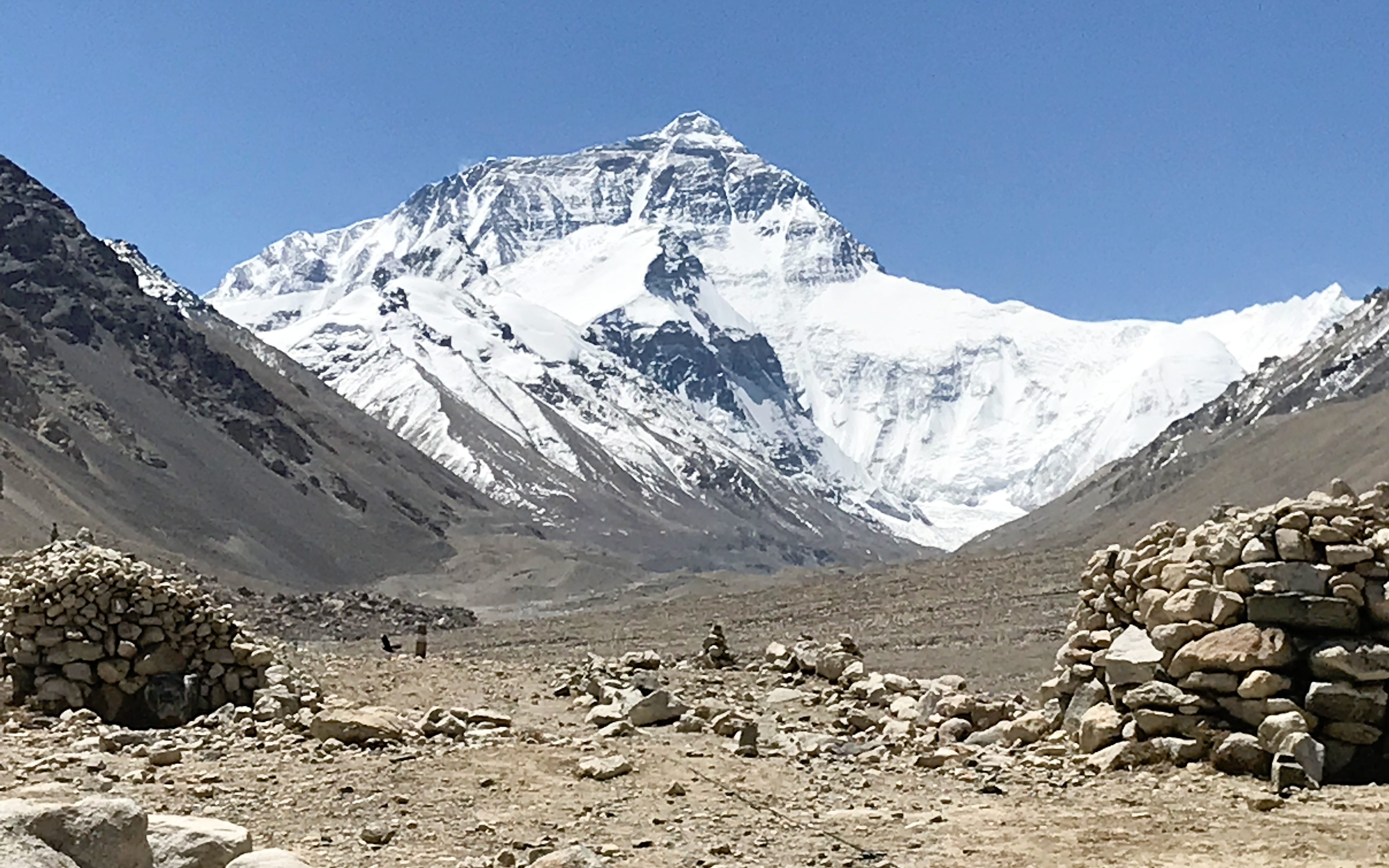
The views were spectacular and the accommodation was basic but serviceable. The night spent in the shadow of Mount Everest (at Rongbuk Monastery) was passed in a traditional tibetan yurt, complete with dung burning cooking stove and yak haired blankets – it was freezing and uncomfortable but, looking back, it was a truly worthy experience.


The China / Nepal Border
From the China / Nepal border I was again left to travel independently to Kathmandu.
Within China the border crossing facilities were good, the service was efficient and all went as expected.
On crossing the Friendship Bridge into Nepal however, this all changed. The Nepalise passport control point was a 2km walk from the bridge. It took the form of a roadside hut and was, to say the least, antiquated in terms of its technology and lacked any basic customer service information.
After a wait of around an hour, and several discussions with other travellers, I eventually managed to get a Nepalise visa appended to my passport.
This though was only the beginning of the differences, compared to neighbouring Tibet.
The Border to Kathmandu
By comparison to Tibet’s excellent roads, the road between the border and Kathmandu was a single laned unpaved dirt track that weaved along the side of mountains, with death defying vertical drops below, and was populated by overloaded trucks and buses, all headed for the border.
It took around six hours to complete the 150km long journey and to be fair, it probably should have taken seven to eight hours at a more sensible driving speed.
To compound the overall obsurdity of the situation, due to my basic miscalculation of the importance of understanding the laws of supply and demand, this journey cost me around 100 US$ after I had stubbornly waited for a non existent bus at the passport control point near to the border. (see a another border crossing experience description here)
Kathmandu
Kathmandu, when I eventually arrived, was everything that I had remembered it to be from my previous visits, albeit it is now more popular than ever with the backpacking community. To recover from my travels I found a friendly bar serving good beer and playing late sixties rock and roll and settled in for the evening.
Flights and Costs
Flights at the start and end of my trip were bought as an open jaw ticket from London to Shanghai and Bangkok to London, with a local flight between Kathmandu and Bangkok thrown in at the end of my travels.
All in all, including flights, accommodation, local travel and food the whole trip cost under £4,000, including a cost of around £1,000 for the eight day escorted tour within Tibet. Not too bad for a 28 day, once in a life time experience.
Detailed Maps and Itinerary
More detailed maps showing this route through:
- eastern China to Nanjing;
- across the Tibetan high plateau to Everest Base Camp and then across the China / Nepal border and onward to Kathmandu
Overview Video
Additionally, a video will be added, providing a photographic record of the key trip highlights, together with animated maps detailing an overview of the itinerary and details of chosen transport modes.