
Disclaimer: Some of the links within this post are affiliate links. This means if you click them and make a purchase I might earn a small commission at no additional cost to you. These commissions, although small, help towards paying the costs of running this website.
Summary
It’s 20 October 2023 and I have arrived in Jakarta from London and plan to spend a month slowly travelling through southwest Java from Jakarta and Yogyakarta and then to fly from Yogyakarta to Denpasar in Bali so as to catch a ferry to Lombok.
Explore your flight options to Jakarta
On Lombok my plan is to spend some time in the Gili Islands and then explore the main island before returning to Bali and flying from there to Flores.
Here, I plan to take a trip to Komodo Island to see the legendary Komodo dragons before spending around six days travelling across Flores from Labuan Bajo to Ende.
My intention is to update this post as my journey progresses
Making Preparations in Jakarta
Days 1 and 2 were inevitably spent recovering from the effects of jet lag, doing a bit of sight seeing and trying to sort out transport options for travelling between Jakarta and Yogyakarta via the southern coastal beach resort of Pangandaran.


For a variety of medical reasons my usual approach of just catching trains and local buses is no longer practical. To sustain me on this trip I have had to bring some 35 to 40kg of liquid food along with me (Following cancer treatment some seven years ago I now suffer from radiation induced swallowing issues and for the last year or so I have been reduced to taking all my food and drink directly into my stomach through a detachable feeding tube – It’s not as dramatic as it sounds, but it does raise practical issues when you need to carry your full month’s supply of food with you – It is also of course more difficult to socialise with other people over a meal or drink when you can’t actually participate in the key activity at hand)
Book your car rental in Indonesia
Anyway, for the first part of the trip the only practical option appears to be either to hire a car and driver or to take a series of long distance taxi rides. Given that I don’t intend to travel every day the taxi option seems preferable, relying on hotel staff to help with the luggage burden at each stopping point.
Travelling on Java
Jakarta to Pangandaran
Driving the 250km from Jakarta to Pangandaran takes around 7 or 8 hours – A toll road is available as far as Bandung but from there the remaining part of the journey needs to be made on single carriageway roads which are almost continually fronted by ribbon development attracted by the income opportunities presented by the road itself.
Average speed on these roads is generally around 30kph due to continual congestion, parking issues and side road traffic activity. Breaking the journey with an overnight stop in Bandung seems a sensible move. It also provides the opportunity to maximise the chances of finding taxi drivers who are willing to make each leg of the trip at a reasonable price.
Bandung turned out to be not very interesting. Its basically an industrial city and transportation hub. It nevertheless provides a useful stop over point before continuing on to Pangandaran. The drive between Bandung and Pangandaran, mainly on Highway 7, was, as expected, tedious and slow. Endless motorbike repair workshops, mini-markets and the odd school adding to the chaos. I just hope that it is all worth it.
All in all, taxi fares from Jakarta to the Pangandaran area amounted to over IND 2 million which seemed to me to be extortionate, given that this is Indonesia. Anyway, so be it. I just need to be more organised in future and identify potential hire options prior to travelling. One thing I quickly discovered though was that the ‘Grab’ taxi app does not seem to work for booking long distance City to City trips.
Pangandaran
To be honest, on arrival, Pangandaran doesn’t excite. It is just a typical local asian seaside resort with some concrete block hotels and fast food outlets. It is obviously popular with locals though as the municipality has set up toll gates around the town where all tourist buses and coaches are charged an entrance fee. The beaches to the west of the town, although mostly deserted, seem to provide good surf. They appear however to be uncared for and in some areas are covered in litter. Activity on these beaches appears to be limited to local usage, perhaps for income purposes as much as leisure.
Near by Batu Karas


Batu Karas on the other hand, a small fishing village some 10km to the west of Pangandaran is something quite different. It has a handful of small hotels and homestays, two or three eating places and a delightful beach divided into coves by a small headland. The eastern beach is mainly a landing point for the village’s fishing boats while the western beach serves as a surfing area for visitors. During my stay, in late October, the surfing opportunities did not appear that great, with relatively small areas of timid surf. This did not deter the surfing brigade from trying to ride the waves though.
I stayed at the Java Cove Beach Hotel which is highly recommended. It is not much to look at from the road but has a swimming pool and gardens built into the hillside at first floor level. Views across the bay from the swimming pool area are superb and food and drink is available poolside. Try to ensure though that you book a first floor room with sea views. The alternative ‘garden view’ rooms are at ground level and look out onto a small courtyard and a wall that divides the hotel from the local sea front road.
Book a room at the Java Cove Beach Hotel
At the the time of my stay the hotel restaurant was being rebuilt but there is a local food restaurant a few metres to the west and the Salt Cafe, some 10 minutes walk to the east, serves a good choice of both western and Indonesian dishes. Be warned though that Batu Karas is a sleepy fishing village and most things are closed down by around 9pm, if not earlier.
Overall, I spent three nights in Batu Karas and it made a pleasant change from the hustle and bustle of Jakarta and the taxi rides to get there.
Batu Karas to Jogyakarta
The onward road trip from Batu Karas to Yogyakarta was as equally frustrating as the journey from Bandung. It took some seven hours to complete to the 200km drive but was marginally cheaper at IND 1.65 million (still expensive though in my opinion).
The last 100km of this journey were considerably quicker than the first 100km as the driver thankfully diverted from Highway 7 onto a newly constructed single carriageway coastal road that extended from west of Kebumen to Yogyakarta airport. This new road is yet to be plagued by the scourge of urbanised ribbon development and therefore travel speed were higher.
One suspects though that it will only be a matter of time before it too deteriorates into the same scenario as the other older route. Signs of the potential for such uncontrolled development are already clear, with an abundance of ‘for sale’ signs being attached to the existing agricultural lands either side of the road and evidence of uncontrolled encroachment development already taking place within the marked out highway rights of way.
Having left Batu Karas at midday (12pm) I eventually arrived in central Yogyakarta at around 7.00pm to a welcoming reception from the staff of the Novotel who obligingly transported my 35 kg of liquid food from the taxi to my sixth floor room.
Yogyakarta
My itinerary only allows for an overnight stay in Yogyakarta before travelling on to Bali via Yogyakarta airport in the morning. In any event, I have previously visited Yogyakarta back in 2016 (immediately prior to my cancer diagnosis) as part of an overland trip from Jakarta to Bali, via Cirebon, Yogyakarta, Solo (Surakarta), Malang, Mt Bromo, Bondowoso and Banyuwangi. The most worthwhile attraction in the area, by far, is the ancient temple at Borobudur.
Buy your local Indonesian ‘Data Only’ E-sims here
On this occasion, I spent the evening enjoying the pedestrianised atmosphere of Jalan Malioboro, the main shopping / tourist street in the centre of Yogyakarta. It is packed full of Batik and other clothes shops, all targeted at both domestic and foreign visitors to the city. After a stroll through the centre, a visit to an ATM and the purchase of essential mineral water I retired to the hotel to administer my final liquid food feed of the day prior to turning in for an early night in preparation for my flight at mid day the following day.


Conclusions on the Overall Value of this Part of my Trip
On the issue of whether this part of my trip was worth all the hassle and cost of getting from Jakarta to Batu Karas and subsequently travelling on to Yogyakarta the truthful answer is that is it questionable.
If you are staying only in western Java then ‘Yes’, visiting Batu Karas is probably worth the hassle. On the other hand, if you propose to travel further afield to likes of Bali, Lombok, the Gili isles and Flores then there are better ways to allocate your time.
Nonetheless, like all travel experiences, you never know till you have experienced it. Do I regret going – No. It was an enjoyable experience once I reached Batu Karas. It was additionally a good education as to the state of Java’s road system. Completion of the country’s long planned extensive toll road system can not come soon enough.
As an aside, if you do need to travel overland between Jakarta and Yogyakarta I would highly recommend using the excellent railway system. It is cheap, comfortable and quicker than using local highways. It is also probably a better option than flying between the two cities, once the time needed for airport transfers, check-in and boarding are factored in.
Travelling long distances by taxi, as I found out to my cost, is both very expensive and time consuming. The old adage of:
‘It’s the journey, rather than the arrival, that makes travel worthwhile’
did not hold true in this case.
Travelling on Bali, the Gili Isles and Lombok
Returning to Sanur, Bali
The AsiaAir flight from Yogyakarta to Bali was generally uneventful apart from being delayed by about 45 minutes. In comparison with my taxi journeys over the last few days it was also excellent value. In total, including an additional 30kg of excess baggage (total 50kg) the cost was around IND 1.5million. Much cheaper even than Ryanair or Easyjet when the luggage costs are taken into account.
Arriving at Bali airport I made use of the airport’s left luggage facility to offload a suitcase full of liquid food bottles. Lightening the load, although necessitating a return to the airport later, means I can travel through Bali and on to the Gili Islands and Lombok like a normal backpacker (almost anyway – I still need to initially carry some 10kg of liquid food feed with me).
Explore your local luggage storage options on Bali
On leaving Bali Airport, as is the case in Jakarta Airport also, finding the taxi rank is not easy. It’s located a considerable walk from the terminal exit. It is also not well signposted. This, thus encourages a proliferation of touts to hassle you to use their vehicles instead of those available at the official taxi rank. Unlike Jakarta though, I also discovered that Bluebird taxis are prohibited from picking up passengers within the taxi rank area. One wonders what behind the scenes deals have lead to this bazaar situation.
Exiting the airport, via my touted, but relatively cheap taxi, immediately taught me that Bali, at least the south of the island, is not the idealistic bliss that it is advertised to be. The roads are heavily congested and even using the toll road from the airport simply deposits you in a traffic jam at its northern end.
Thirty years ago, while working in Dhaka, Bangladesh, I visited Bali with my family for a rest and recreation escape from the chaos of Dhaka. For the first part of that holiday, prior to renting a car and undertaking a road trip around the northern part of the island, we stayed in Sanur, a idyllic beach resort, and stayed at the Swastika Guest House. Noticing on ‘Agoda’ that it still exists I decided to return there for an overnight stay on my way to connect with the Gili Island ferry at Padang Bai.
Oh, what a mistake – the idyllic beach resort is now a sprawling low cost, over developed, mess. Where once the Swastikita Guest House fronted onto a sandy road separating it from sand dunes leading to the beach, it is now located on one of the resort’s many thoroughfares. Both sides of the road are developed with what can only be described as low quality tourist facilities and the dunes area now seems to be part of a large construction site, presumably providing yet more tourist facilities and accommodation.
Any charm that Sanur once had has now been obliterated by an incessant quest to milk the goose that laid the golden egg. Sanur now just seems to be another Kuta, but unlike Kuta it doesn’t benefit from a west facing sunset beach and it also doesn’t have Kuta’s undeniably appealing (for some) nightlife.
Suprisingly though, amongst all of this chaos, the Swastika Guest House itself still has a certain appeal. To adjust to the changing outside environment it has been extended toward the road through building a two story buffer area that shields the pool area and most of the guest rooms from the traffic noise and activity on the adjacent street. If one could just stay in the guest house, without venturing outside, it would still be a good place to stay. That’s just not what vacations are about though.


They say ‘You should never go back’. In Sanur’s case this could never be truer.
Onward to Gili Trawangan
The main departure point for Lombok from Bali is the port of Padang Bai. It is located about 40km and just over one hour north of Sanur. Thankfully, as Sanur fades into a distant memory, the traffic thins out and finally, for the last 5km into the port town, both the the scenery and the road side development becomes more pleasant.
The port itself is little more than a fishing village, with a bustling jetty and an associated small scale ticket booking industry. Be warned though, the jetty itself is generally chaotic, with hundreds of packpackers waiting for numerous fast boats that depart every hour.


Passenger information is virtually non existent but thankfully, a highly efficient and incredibly simple boarding process is employed. This is based around each passenger being provided with a boarding pass in the form of a departure specific colour coded neck tag. These neck tags allow you, as a passenger, to easily identify fellow passengers waiting for the same fast boat and also for the fast boat crew to round up their customers from amongst the hordes of backpackers.
My boat to Gili Trawangan was scheduled to depart at 1.30pm, so I was told, but eventually left at 2.15pm. The boat was serviceable and probably held around 100 passengers. All luggage was collected and stored by the crew at the front end of the of the vessel and similarly deposited on the quayside when we arrived at the public landing point on Gili Trawangan. The fare was around IND 100,000 and the trip took a little over two hours.
Looking back from the fast boat towards Bali as we initially followed Bali’s northeastern coast line it appeared that life in this northern section of the island had so far been spared the impacts of developers. Maybe it is therefore only the southern areas of Denpasar, Kuta and Sanur that have been ravaged by the scourge of overdevelopment and rampant commercialism.
Relaxation in Gili Trawangan
Gili Trawangan is a world apart from Sanur. Despite it being billed as the ‘party island’ of the three northern Gilli Islands, in late October at least, it appeared very relaxed, laid back and almost quiet. This is helped by all forms of motorised transport being prohibited on all three of the northern Gili islands. All transportation, including goods delivery, is therefore undertaken by horse drawn trap or pedal cycles.
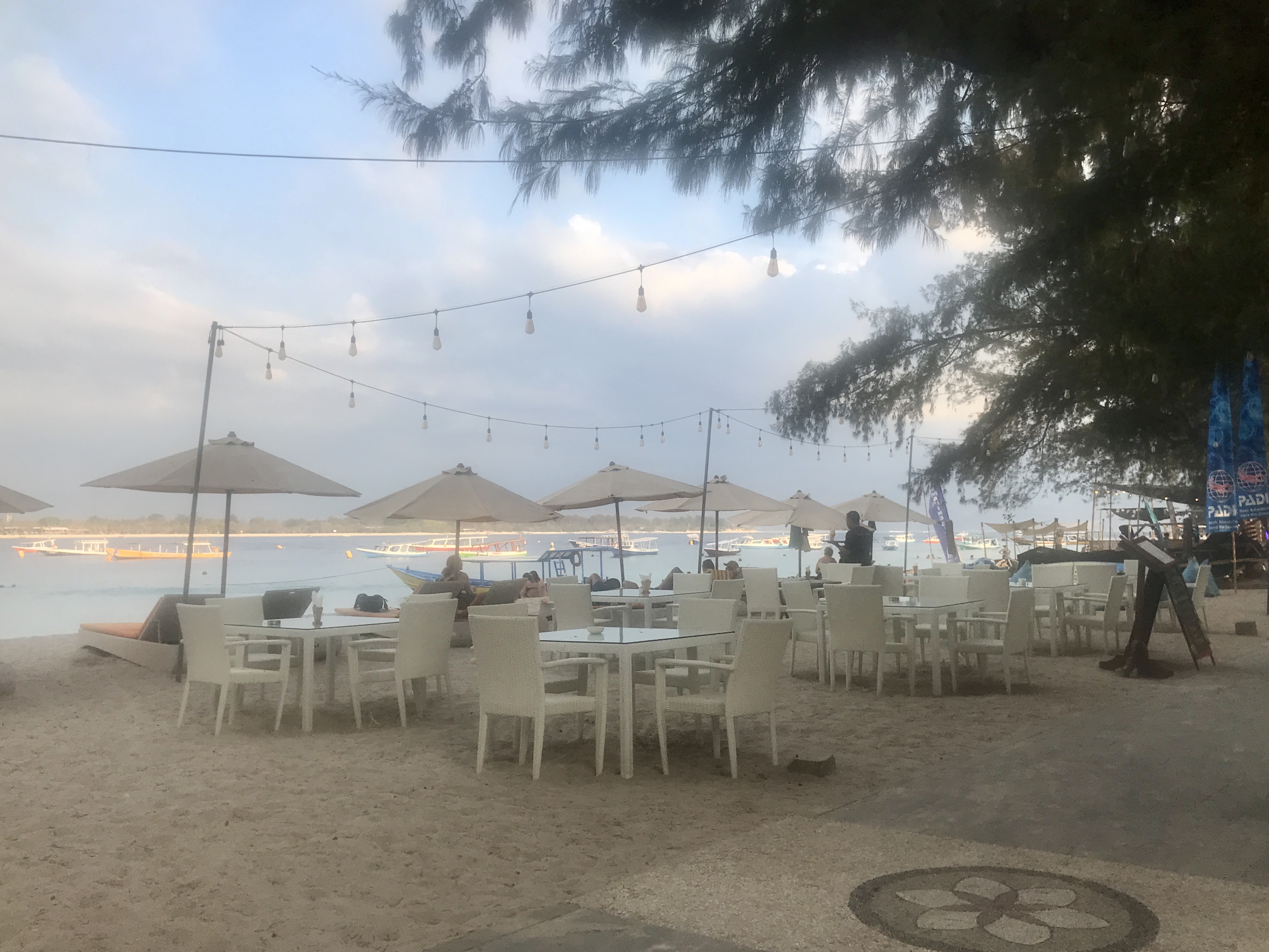
The beach is clean, almost white in colour. The guest houses are separated from the beach by a narrow thoroughfare used solely by pedestrians, cycles and small horse drawn traps. The upper part of the beach is home to beach bars / food eateries and sunbeds while the shoreline is home to small fishing and pleasure boats, swimmers and snorkelers. All of this is set against the blue / green azure of a crystal clear sea and the blue of a sunkissed sky.


What more could one want from a paradise island – Perhaps only the absence of all of the above manmade features, I might hear you say – If indeed this is what you desire, other parts of the island’s shoreline, further away from the eastern public landing quay can offer this too, as can the quieter Gili Air to the south.
I spent my three nights on the island at the Lonely Planet listed Blu d’a Mare. This offers a collection of around half a dozen 1920’s Javanese bungalow houses set in a garden setting with small pool. Each bungalow features old wooden floors, air conditioning and a modern sunken bathroom, complete with fresh water shower. All of this at the give away price of IND 700,000 per night.


Blu d’a Mare, Gilli Trawangan
Needless to say, I spent my two full days in Gili Trawangan relaxing on a sun bed, strolling around the beach front area, getting eight days of laundry washed and catching up on writing parts of this blog post.
A Short Trip to Lombok
Like all good things, my time in Gili Trawangan must come to an end if I am to carry on my journey across Indonesia. So, with reluctant heart, I have now packed my bags and am heading for the fast boat to Bangsal on Lombok’s mainland.
My first surprise of the day is that the public boat service between Gili Trawangan and Bangsal is considerably more passenger friendly than its private sector competitors. Boarding is done from a jetty that is level with the boat, avoiding any need for perilous leaps of faith between the jetty and the boat, and it leaves on time. In no time at all we arrive in Bangsal, via stops at Gili Menon and Gili Air.

View from rear of Public Boat, Gilli Trawangan to Bansal
Maybe it’s because I look old and decrepit or maybe I just look like easy prey, but for some reason all of the taxi brokers and ‘would be’ porters seem to make a beeline towards me once the boat has docked. To be fair though, I am probably the only foreigner on the boat that looks over 40.
Anyway, given my increased luggage burden (and my real life decrepitness) I quickly give in to their persuasive offers of assistance and am whisked off the boat and towards a waiting taxi. After much haggling we agree an exorbitant sum of IND 250,000 for the 20 minute ride to my hotel in Sengiggi – I know I have been done, but at half the cost of a similar ride in the UK, with porterage services included, I feel quietly happy to be on my way.
Sengiggi, Lombok
My hotel for the next two days is the rather ordinary sounding Holiday Resort, Lombok, chosen primarily because it was considerably cheaper than its exclusive sounding neighbours.
On arrival though, it has all the trappings of an exclusive 5 star resort hotel, a palacios semi open air lobby area, a large kidney shaped swimming pool with exclusive bar and sunset facing terrace area and attractive and spacious sea view facing semi detached bungalows. My bungalow comes complete with a semi open air sunken bathroom with its own jacuzzi and separate shower area. Can this really only cost IND 1,100,000 per night – Way above my targeted budget for the holiday but a steal by western standards.


The Holiday Resort, Sengiggi, Lombok
The only disappointments, especially after having stayed in Gili Trawangan, is that the beach is made up of an uninviting black sand and appears to be deserted. Also, the whole place has a disconcerting air of order and respectability about it which doesn’t sit comfortably with my more laid back approach to life. It is additionally rather galling that I can’t partake of the cordon blu restaurant facilities or the drinking of cocktails on the sun terrace. Finally, after a recent experience of finding myself stuck in a bathtub in the Lake District, without the required strength to extradite myself, I think I will give the jacuzzi a miss as well
Never mind, it’s good to be alive and to be here at all.
Sightseeing in Central and Northern Lombok
Determined to see more of Lombok as part of my short stay, I hire a car and driver for the day. The plan is to visit the countryside, see some batik weaving, some rice fields and waterfalls and then follow a part of the coastal road around the north of the island. Like all such plans, especially when then are hastily put together, the reality does not always match up to expectations.
In general, the central areas of Lombok are a bit disappointing. They consist of fairly low lying agricultural areas with a mix of farmland and low income rural development.
- The batik weaving centre, although interesting from its community cooperative approach to working, amounted to little more than an outlet shop for their products.
- Although there were rice fields to be seen these were generally dried out because of the lack of rain – everyone (apart from me) is apparently eagerly waiting for the wet season to start.


Traditional Batik Weaving, central Lombok


Rice Growing, central Lombok
The waterfalls were a bit more of an adventure. As one might expect, these are located in the foothills of Lombok’s northern mountains and are difficult to reach. The pathed road ends about 3km or 4km short of the falls. To cover the remaining distance it is necessary to either walk or ride pillion on a motorcycle. Against my better judgement my body decides that walking is not an option so pillion motorcycle riding is the only way forward. After a hair raising 15 minute minute ride we arrive some 250 steps above the falls. The downward trek is difficult enough due to the poor condition of the steps and the lack of any hand rails. Coming back up was another story – fortunately my guide had strong arms (and a lot of patience) to assist me over the difficult areas. It was all worth it however as the photos below testify.


Benang Kelambu Waterfall, central Lombok
The last part of the trip along the northern coastal road is more rewarding. A mixture of high altitude viewing points and local beach scapes provide some rewarding photo opportunities.


The north coast of Lombok
Returning to Bali and the Airport
After two nights on Lombok it is time to make my way back to Bali Airport, via the delights of Kuta, and then an onward flight to Flores and the Komodo dragons.
My journey back to Bali was fairly uneventful, apart from some fun and games negotiating taxi fares in Padang Bai, prior to spending a rather depressing night in Kuta.
Kuta, An Aussie’s Benidorm
As already expected, Kuta had all the charm of its partner, Sanur, except it does it better.
My hotel was an Ibis chain offering, cheap and cheerful and delivered with all the efficiency of an anonymous boarding house.
A walk after dark around the streets further reinforced my expectations. Street after street of Aussie bars full of drunken holiday makers determined to have a good time on cheap booze and late night openings, albeit, most of the bars seemed to be shedding customers by around 10.00pm.
A bit like watching the losing side’s spectators at a premier league football match. All expecting a good night out and realising that things aren’t going to be as they might have expected.
Never mind, it was somewhere to pass the evening away while waiting to board my flight in the morning to Labuan Bajo.
Conclusions on Bali, the Northern Gilli Isles and Lombok
Based on my short duration visit to these three areas my conclusions are that
- Bali has seen better days. This once idyllic island has now succumbed to the impact of mass tourism. The southern part of the island is already over developed and chocked with traffic and package deal Aussie holiday makers. It can only be a matter of time before this extends across much of the island
- the northern Gillis, by contrast, although very tourist orientated, are still generally an idyllic paradise of sandy beaches, clear blue seas and small privately run local hotels. The complete absence of motorised traffic adds to their appeal
- Lombok, based on the areas I visited, is still generally unaffected by the impacts of mass international tourism. This is perhaps mainly because, although interesting to visit for its rural way of life, it’s rice fields, waterfalls, scenic coastline and northern mountains, it does not really offer an outstanding awe inspiring experience.
Flores and Komodo National Park
Arrival at Labuan Bajo Airport
My first impressions of Labuan Bajo were not good. The airport appears to have been designed by a planner who has never travelled with luggage.
In several locations there are no ramps or lifts between different levels and then, as if to add insult to the misery, all of the ATMs are located in the basement. An area which is totally inaccessible to anyone who doesn’t want / is incapable of lugging luggage down two flights of stairs – How do people with disabilities manage in places like this.
Not a good start, especially as I am short of local rupees to pay the taxi driver. Problem solved though by negotiating a fee in dollars. Slightly expensive but needs must.
The Blue Parrot, Labuan Bajo
Everything gets better when I arrive at my hotel. Although a bit further from the centre than I had realised the Blue Parrot is perfect. It’s located in an elevated position above the town and provides spectacular views across the bay from its back room terraces.
The owner is also super helpful in providing contacts for boat trips to Komodo National Park and drivers if you want to explore Flores. In addition, he speaks word perfect colonial English so no worries over language confusion.
It’s a bit on the expensive side but the room is spacious, with its own on-suite bathroom and a private west facing terrace from which you can watch both the activities in the bay and the spectacular sunsets.
As a bonus, the Blue Parrot is also located next to the Escape Bajo cafe / restaurant which offers a good range of food.
Just as well really, as all of the town’s other restaurants are a fifteen minute walk away. It’s all uphill on the way back as well. A pillion motorcycle taxi may be the best option for the return trip if, like me, you are challenged by excessive exercise.
Getting to Komodo National Park
My trip to Komodo National Park is arranged, through text messaging, late in the evening. It’s agreed that I will be picked up from the hotel at 6.30am next morning.
At 7.30am there is still no sign of a pick up, despite several texts to confirm it’s coming. Eventually at 8.00am I receive a call asking why I’m not at the boat. Another exchange of texts follows and eventually a car arrives, I’m hurriedly driven to the port and bundled into the boat minutes before in departs.
Later it transpires that the Labuan Bajo annual marathon started in the town this morning and caused traffic chaos all around the port area. The issues I experienced may therefore be a one off.
Padar Island, Komodo National Park
This boat trip, which was hurriedly organised without much planning, apparently visits much more than just the dragons of Komodo.
It includes stops at Padar Island, Pink Beach, Komodo Island (The Dragons), Taka Masakar, Manta Point and Siaba Island. Also included in the experience are opportunuties for swimming and snorkelling as well.
At nearly 70 I don’t think I’ll be participating in either. Just climbing on and off the boat in knee deep water is enough of an adventure for me.
At Padar Island (first stop) we fortunately join and leave the boat via a pier. Even this though involves clambering up and down a narrow staircase perched over the harbour.
Padar Island appears to be completely undeveloped. The spot where we land is within a small bay flanked by headlands. The beach itself is pleasant, although not spectacular. Its major highlight on this occasion is the arrival of a couple of deer who join us on the beach foraging for food. The deer are foraging, not us.

An hour of this rural tranquility is more than enough for most of us. It’s back to the pier with my 40 or so other travellers and off we go to our next stop , Pink Beach.
Pink Beach, Komodo National Park
What can I say, this is paradise on earth. Clear waters, pink sands, blue sky, rocky islets and a beach cafe selling cheap Indonesian food.
Sitting on the sands though it is a bit hot. I should have brought sun screen and a hat with me, The latter is quickly solved by a beach seller peddling ‘Komodo National Park’ hats. No sun screen though, but the brim of the hat is sufficient to shade my neck at least.
I think this place is idealic. I just hope that the area’s status as a National Park and UNESCO site helps to preserve it for future generations to enjoy – Again the dilemmour between the increasing demands of tourism and the need for conservation comes to mind.
Can Indonesia, and other neighbouring countries for that matter, really be expected to singularly preserve the wonders that they possess. Maybe UNESCO and other international conservation societies should be providing greater financial assistance in this respect. After all, the benefits of such preservation will be realised internationally, not just within Indonesia
Komodo Island, Komodo National Park
Visiting Komodo Island itself is all about the dragons.
On arrival our small boat party is herded into a holding area with several other groups in readiness for a guided tour of the island and bit of dragon spotting.
Prior to my visit I had a vision that this would be all about viewing the dragons in their natural state, from hides set amongst the landscape of the island. I also expected the dragons to be active, striding across the landscape, perhaps fighting over food with each other or going about their lives with purpose.
In reality none of these things materialised. All that happened was that we were taken on a one hour walk through a wooded part of the island. Every now and again our party was halted to watch what appeared to be a domesticated dragon basking under a tree half asleep. None of the half a dozen dragons I saw could even be bothered to raise its head in recognition of it’s visitors, let alone actually get up and move.


A best I must assume that the local guides keep them well feed so that they remain ‘onside’, both willingly participating in the unfolding circus, while not causing any danger to visitors. A worst, all the dragons I saw were deliberately drugged with something or other to keep them quiet.
Either way, the presence of hoards of tourists descending on this island can not be described in any way as being beneficial to the dragons themselves. In my opinion the whole experience was little better than that of visiting a zoo.
Never mind, I suppose I should have known it would be a disappointment. I just feel sorry for the dragons. Hopefully there are others on the island still living a ‘natural’ life away from the tourist ‘circus’.
To add to the above disappointment further disaster struck upon returning to our boat. Somehow I managed to mislay my fellow ‘boaters’ and in a moment of panicked confusion I convinced myself I had found them. They were already departing from a boat via a steep narrow staircase leading down from the pier. Gallantly, l followed them down the staircase to boat, only to be turned away at the last moment by the captain. As the boat set sail out into the harbour my first thought was, ‘wow, that was a lucky escape’. However, maybe it wasn’t. I was then left all alone at the bottom of this steep narrow staircase overlooking the sea. Panic set in as I realised that one misplaced footstep would mean I plunged into the sea below. I froze, not able to move in any direction, and bellowed out for help. Thankfully, I was rescued by a young man on the quaysude who came to my assistance and guided me back up the steps. I don’t think I have panicked like that for a long time. I still have nightmares just thinking about it.
Rescued, I then suddenly discover the whereabouts of my fellow ‘boaters’ and return to the fold, trying to pretend that nothing had happened
Thankfully, we soon departed Komodo Island and proceeded to our next destination.
Komodo Island will now live in my memory for all the wrong reasons.
#Indonesia #Java #Bali #Lombok #Flores #GiliIslands #GiliTrawangan #Jakarta #BatuKaras #Pangandaran #Yogyakarta #Sanur #PadangBai #Sengiggi #komododragons #komodonationalpark


Leave a Reply